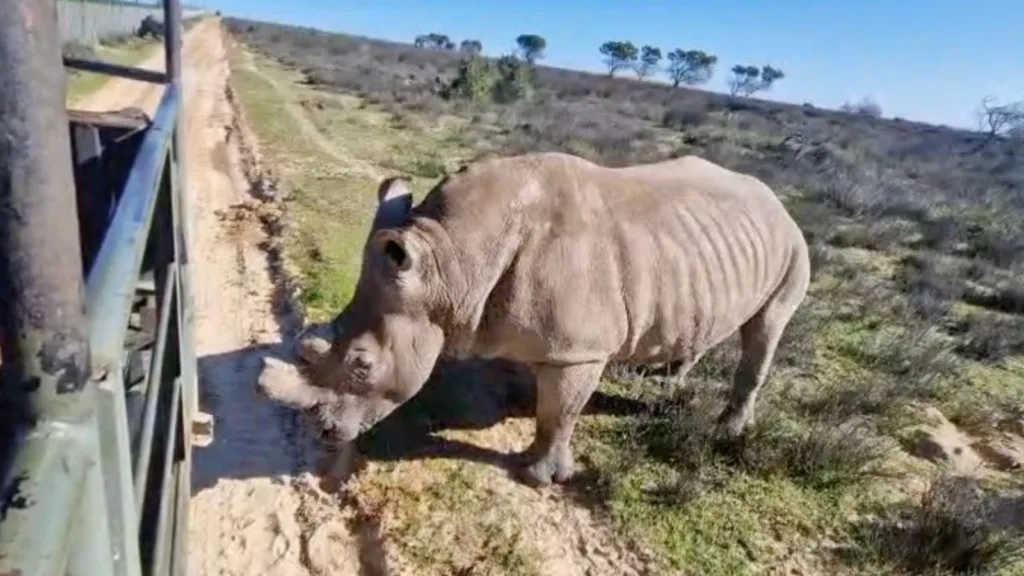
Meet Max: The Rhino Who Tried to Tip Over our Safari Vehicle
Our rhino encounter in South Africa started innocently enough. We were on a game drive in the Western Cape when Max, a rather large white rhino, decided our vehicle deserved his undivided attention.
At first, he was simply watching us.
Then he stomped the ground and charged towards us.
Now, watching the video afterwards, it doesn’t look particularly dramatic. Max isn’t thundering towards us at full speed. Nobody is screaming. The vehicle isn’t careering backwards.
Inside the vehicle, however, things felt rather different.
Because when several tonnes of rhino are coming directly towards you, the distinction between walking purposefully and charging suddenly feels remarkably unimportant.
Meet Max
Max approached the Unimog head-on, lowered his head, and put his horn and considerable weight underneath the vehicle, as though he might like to rearrange it. Fortunately, a Unimog is an exceptionally heavy piece of machinery.
Max pushed.
The Unimog stayed put.
We sat inside looking considerably calmer than we felt.
We’d been told that a lighter vehicle could potentially be in trouble with that amount of rhino underneath it, which wasn’t an especially comforting thought while we were sitting there.
Eventually Max moved away and normal breathing resumed.
And then we discovered something.
Apparently, Max does this rather a lot.
What had felt to us like a potentially significant wildlife incident was, it seems, fairly standard Max behaviour.
We had just met the local troublemaker.
A Little Something About White Rhinos
You might notice that Max’s horn is considerably shorter than you’d expect.
Sadly, rhinos are relentlessly targeted by poachers for their horns, which is why many conservation programmes have resorted to dehorning as a protective measure.
Interestingly, rhino horns aren’t bone. They’re made primarily of keratin, the same protein found in our fingernails and hair. And just like our nails, they continue to grow.
This means dehorning isn’t a once-off exercise. Depending on the conservation programme, the procedure generally needs repeating every one to three years as the horns grow back.
And a couple of other things you might not know about white rhinos:
Despite their name, they’re actually grey, can weigh well over two tonnes and can reach speeds of around 40 km/h over short distances.
Thankfully, Max wasn’t particularly interested in demonstrating that last talent.
The Bit You Don’t See on Instagram
Rewatching that video makes us laugh because it doesn’t remotely capture what was happening inside that vehicle.
We look calm.
We were not calm.
Once it was over, everyone admitted pretty much the same thing: we’d pooped ourselves.
And that is perhaps one of the things we love most about travelling in South Africa.
You can plan the route. Book the accommodation. Research the restaurants. Make a list of everything you want to see.
And then a rhino called Max wanders over and becomes the story you tell everyone afterwards.
For Max, apparently, just another day at the office. For us? Several years off our life expectancy. 🤣


